
A Science-Backed Comparison of Two Iconic Members of the Deer Family
Discover science-backed white-tailed deer vs. elk facts about size, speed, antlers, social behavior and adaptability. This wildlife comparison explains how these two members of the deer family are uniquely adapted to different environments.
Introduction
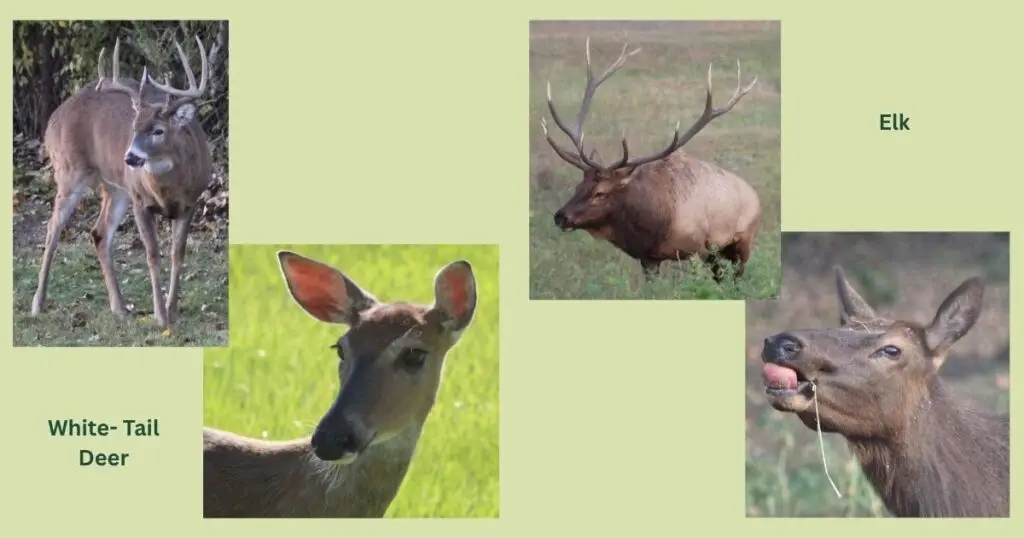
White-tailed deer and Rocky mountain elk are both members of the deer family, Cervidae, but these two animals are built very differently.
White-tailed deer (Odocoileus virginianus) are widespread, highly adaptable animals capable of living in forests, farmland, wetlands and even areas close to human development. Elk (Cervus canadensis) are much larger members of the deer family that often travel in herds and can move across large landscapes as seasons and food availability change.
Both species rely on speed, sharp senses and seasonal antlers for survival, but their size, behavior and lifestyles reflect different evolutionary strategies.
White-tailed deer rely heavily on agility, camouflage and the ability to quickly disappear into thick vegetation. Elk rely more on size, strength, herd behavior and powerful movement across large landscapes.
So instead of asking which animal is “better,” let’s ask a more interesting question: how are white-tailed deer and elk different and what do those differences tell us about the way each animal survives?
1. Size: Which Is Bigger?
Short Answer:
Elk win this category — by a very large margin.
What the Science Says
White-tailed deer are medium-sized members of the deer family. Their size varies depending on sex, age, genetics, food availability and geographic region.
Adult white-tailed bucks are larger than does. Many bucks weigh roughly 110 to 300 pounds, although exceptionally large individuals can weigh more. Does commonly weigh around 80 to 160 pounds.
Elk are dramatically larger.
Adult bull elk commonly weigh several hundred pounds, with large males reaching roughly 700 to 1,000 pounds depending on the subspecies and region. Cow elk are smaller than bulls but can still weigh around 300 to 500 pounds.
Elk also stand much taller. A mature elk can stand approximately 4½ to 5 feet at the shoulder, while white-tailed deer generally stand around 3 feet tall at the shoulder.
A large bull elk can therefore weigh several times as much as an average adult white-tailed deer.
Interpretation
The elk’s massive body gives it an advantage in physical strength and competition with other elk.
White-tailed deer follow a different survival strategy. Their smaller bodies make it easier to move through forests, brush and other dense environments.
Instead of relying on massive size, whitetails rely heavily on quick reactions, agility and concealment.
Winner: Elk — their dramatically larger bodies put them in an entirely different weight class.
2. Speed and Agility: Which Moves Better?
Short Answer:
Elk may have the advantage in top running speed, but white-tailed deer have an advantage when it comes to agility through dense terrain.
Scientific Evidence
White-tailed deer are extremely agile animals.
They can run at speeds of roughly 30 miles per hour or more and are capable of bounding rapidly through forests, brush and other difficult terrain.
Their relatively small bodies and long legs allow them to change direction quickly while escaping predators.
White-tailed deer are also powerful jumpers. They can clear obstacles several feet high and make long horizontal leaps when fleeing danger.
When frightened, a white-tailed deer often raises its tail, exposing the bright white underside. This behavior is commonly called flagging.
Elk are also surprisingly fast despite their much larger size.
A running elk may reach speeds estimated around 40 miles per hour over short distances. Their long legs and powerful bodies allow them to cover open areas quickly and travel long distances across forests, valleys and mountain landscapes.
However, maximum speed is only part of the story.
A white-tailed deer can dart between trees, leap over obstacles and make sudden changes in direction in thick vegetation where a much larger elk has less room to maneuver.
Interpretation
Elk are powerful runners built to move efficiently across large landscapes.
White-tailed deer specialize more heavily in evasive movement.
When a whitetail detects danger, its survival strategy often involves making rapid turns, bounding over obstacles and quickly reaching thick cover.
The elk has the advantage in raw speed and power, while the white-tailed deer has an impressive advantage in tight, complicated terrain.
Winner: White-Tailed Deer for agility — elk bring tremendous speed and power, but whitetails are masters of evasive movement through dense terrain.
3. Antlers: Who Has the More Impressive Rack?
Short Answer:
Elk win this category — their antlers can become enormous.
What We Know
Both white-tailed deer bucks and bull elk grow antlers.
Unlike permanent horns, antlers are made of bone and are normally shed and regrown every year.
While growing, antlers are covered by a soft layer of tissue known as velvet. The velvet contains blood vessels that provide nutrients to the rapidly developing antlers.
Once the antlers finish growing and harden, the velvet dries and is rubbed away.
White-tailed bucks grow branching antlers that extend from main beams. Their antler size varies greatly depending on age, nutrition, genetics and health.
Bull elk grow much larger antlers.
The antlers of a mature bull elk can extend several feet above and behind its head. Large racks may span close to 6 feet and weigh around 30 pounds or more.
Bull elk use their antlers during the breeding season for visual displays and physical competition with rival males.
White-tailed bucks also use their antlers during the rut. Bucks may spar or fight by locking antlers while competing for dominance and access to receptive females.
Interpretation
Both species use antlers primarily in connection with breeding competition.
However, the elk’s enormous body allows it to support a much larger set of antlers.
A mature bull elk carrying a fully developed rack is one of the most impressive sights among North American mammals.
Winner: Elk — their enormous antlers are among the most spectacular structures produced by any member of the deer family.
4. Social Life: Who Is More Social?
Short Answer:
Elk are generally much more social.
Scientific Evidence
White-tailed deer can form groups, but their social structure usually involves relatively small associations.
Does may travel with their fawns or other related females. Bucks may sometimes form small bachelor groups outside the breeding season.
As the rut approaches, bucks become increasingly focused on finding receptive females and competing with rival males.
Elk are much more strongly associated with herd living.
Cow elk, calves and younger animals may gather in groups that can become quite large. Mature bulls may form separate bachelor groups outside the breeding season.
During certain times of year, elk herds can contain dozens or even hundreds of animals.
During the rut, dominant bulls attempt to gather and defend groups of females.
Bull elk also produce their famous bugling calls during the breeding season. These loud calls can advertise a bull’s presence and challenge competing males.
Interpretation
Herd living gives elk several advantages.
More animals mean more eyes, ears and noses available to detect possible predators.
Living in groups also allows elk to maintain social relationships while traveling across large landscapes.
White-tailed deer use a looser social strategy. Smaller groups and solitary movement can make it easier for them to remain hidden in forests and brush.
Winner: Elk — they are much more strongly adapted to life in large social herds.
5. Adaptability: Who Can Live in More Human-Altered Environments?
Short Answer:
White-tailed deer win this category.
Scientific Evidence
White-tailed deer are among the most adaptable large mammals in North America.
They can live in:
- Forests
- Farmland
- Grasslands
- River corridors
- Wetlands
- Suburban environments
- Forest edges
Whitetails often thrive in edge habitat, where forests meet fields, meadows, farms, roadsides, lawns or other open areas.
Human development can unintentionally create large amounts of this type of habitat.
White-tailed deer also eat a wide variety of foods, including leaves, shoots, grasses, shrubs, fruits, nuts, fungi and agricultural crops.
That flexible diet allows them to survive in many different environments.
Elk can also occupy a wide range of natural habitats, including forests, grasslands, valleys, meadows and mountainous regions.
However, elk generally require much larger landscapes. Some populations move considerable distances as seasons, snowfall and food availability change.
Their larger bodies and herd lifestyles also mean they require more food and more space than white-tailed deer.
Interpretation
The white-tailed deer’s ability to survive near people has helped make it one of North America’s most widespread large mammals.
A patchwork of forests, fields, farms and suburban neighborhoods can provide both food and hiding places for whitetails.
Elk are highly adaptable wild animals too, but their much larger bodies and social lifestyle generally require more space.
Winner: White-Tailed Deer — few North American large mammals have adapted to human-altered landscapes as successfully.
Comparison Table
| Category | Winner | Why |
|---|---|---|
| Size | Elk | Bulls can weigh several times more than a typical white-tailed deer |
| Speed & Agility | White-Tailed Deer | Smaller bodies allow extremely agile movement through dense cover |
| Antlers | Elk | Mature bulls can grow enormous antlers spanning several feet |
| Social Life | Elk | Elk commonly live and travel in much larger herds |
| Adaptability | White-Tailed Deer | Whitetails thrive in forests, farmland, edge habitat and suburban environments |
Why These Differences Exist
These traits reflect the different environments and survival strategies of the two species.
White-tailed deer evolved around concealment, agility and adaptability. Their smaller bodies allow them to maneuver quickly through forests and thick vegetation. Their brown coats provide camouflage, while their powerful legs help them escape predators through rapid bursts of movement, jumping and sudden changes in direction.
Their flexible diet also allows them to take advantage of many different food sources.
Elk evolved around size, mobility and social living. Their large bodies allow them to move across substantial landscapes, survive colder environments and compete physically during the breeding season.
Herd behavior provides another layer of protection because many animals can watch, listen and smell for potential danger.
The differences become especially noticeable during the breeding season.
A white-tailed buck may travel extensively while searching for individual receptive does and competing with other bucks.
A dominant bull elk may attempt to control a group of cows while bugling, displaying his antlers and challenging rival bulls.
Both strategies work — they simply represent two very different ways of surviving as members of the deer family.
Quick Answer: Are White-Tailed Deer or Elk Better at These Wildlife Face-Offs?
Elk win when it comes to size, antlers and large-scale social behavior, while white-tailed deer have the advantage in agility and adaptability to human-altered environments.
Elk are built around size, strength, herd behavior and powerful movement across large landscapes.
White-tailed deer are built around agility, camouflage, quick escape and the ability to survive in an enormous variety of habitats.
Neither animal is universally “better.”
Each is exceptionally well adapted for the environment and lifestyle in which it evolved.
Final Thoughts: White-Tailed Deer and Elk Both Win
Elk may tower over white-tailed deer, but bigger does not automatically mean better adapted.
Elk dominate the size and antler rounds. A mature bull can weigh several times as much as a whitetail and carry an enormous rack while competing with rival bulls during the rut.
White-tailed deer take a completely different approach to survival.
Their smaller bodies make them highly agile. Their ability to leap, turn quickly and disappear into dense vegetation can make them surprisingly difficult for predators to pursue.
Perhaps most impressive is their adaptability.
White-tailed deer have learned to survive in environments ranging from remote forests and wetlands to agricultural areas and suburban neighborhoods.
That is what makes this Face-Off interesting.
White-tailed deer and elk belong to the same family, yet evolution has produced two animals with remarkably different lifestyles.
One became a massive, social herd animal.
The other became an adaptable woodland escape artist.
Both strategies have proven remarkably successful.
Which round surprised you the most — size, speed and agility, antlers, social life or adaptability?
Share this White-Tailed Deer vs. Elk Face-Off with another wildlife lover and see which animal they think wins each round.
Sources
National Park Service — White-Tailed Deer
Website: nps.gov
National Park Service — Elk, Rocky Mountain National Park
Website: nps.gov
National Park Service — Elk, Yellowstone National Park
Website: nps.gov
National Park Service — Horns vs. Antlers
Website: nps.gov
Animal Diversity Web — White-Tailed Deer (Odocoileus virginianus)
Website: animaldiversity.org
Smithsonian’s National Zoo & Conservation Biology Institute — North American Elk
Website: nationalzoo.si.edu
Michigan Department of Natural Resources — White-Tailed Deer
Website: michigan.gov/dnr